Robert Neville
I Am LegendRobert Neville is the central human consciousness of the novel and its decisive reversal. Living alone amid the aftermath of the plague, he protects his house, hunts the infected, studies the disease, and tries to preserve a rational account of a world that has been organized around superstition. His eventual discovery of the vampiris bacillus gives the epidemic a material explanation, yet scientific knowledge does not save him. By the end, the surviving society regards him as an abnormal and terrifying scourge. Robert Neville’s final insight is therefore both personal and historical: normality belongs to the majority, and he has become the legend that the new world will remember.
Identity and Isolation
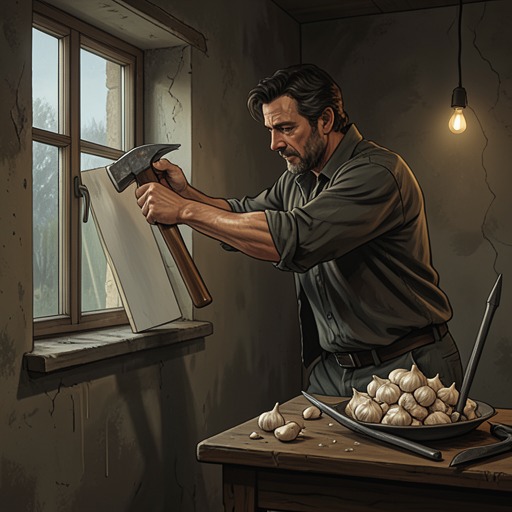
Robert Neville’s daily existence is defined by solitary maintenance. In January 1976, cloudy weather makes sunset difficult to judge, and he stays close to Robert Neville’s house because the vampires may arrive before he can return. He circles the building in the gray afternoon, smoking while checking every window for loosened boards. Their attacks regularly split or pry the planks from the walls, forcing him to replace them, a labor he detests but cannot abandon. The house is not merely shelter; it is a repeatedly damaged defensive boundary whose condition determines whether he survives the night.
His isolation also alters his standards of ordinary domestic life. After repairing the defenses, he leaves garbage accumulated for five days in the kitchen sink and postpones burning paper plates, cleaning the furniture, washing the sinks and bathroom fixtures, and changing the bedding. The reason is not ignorance but exhaustion and emotional depletion: he is a man alone, and these tasks have lost their former importance. His routine combines practical vigilance with neglect, showing how survival has displaced the social and domestic habits that once gave human life its shape.
The isolation is auditory as well as spatial. For five months he has listened to the vampires outside and wishes that he had soundproofed the house. He no longer watches them through the peephole because the women, after noticing him, began striking obscene postures to entice him outdoors. Yet he refuses to seal himself completely away with earplugs, since doing so would also silence his music and make it seem that the vampires had forced him into a shell. His reading, Brahms, cigarettes, and whisky become fragile instruments of self-command against the voices and gestures outside.
Life and Plot Trajectory
Robert Neville responds to the catastrophe through repeated acts of defense and investigation. During the day he repairs boards, gathers garlic from the hothouse, searches houses, and uses wooden stakes against sleeping vampires. The garlic that initially made him physically ill becomes so pervasive that its smell seems to cling to his house, clothes, and even flesh. His weapons and protective measures are practical adaptations, but they also expose the cost of turning the entire day into preparation for another siege.
His encounters with vampire women reveal the conflict between physical impulse and deliberate action. When he finds a sleeping woman in a red housecoat, his hands fumble over the stake and mallet. Killing women is especially difficult because the encounter awakens a bodily demand that he experiences as senseless and irrational. He forces the desire down and proceeds while trying to convince himself that the act is necessary. The episode makes his violence neither effortless nor morally simple: he performs it as a survival duty while recognizing the sexual pressure and emotional disturbance intertwined with it.
Robert Neville’s campaign is extensive and repetitive. After one day’s work he goes from house to house until all forty-seven of his stakes have been used. At night, however, the vampires retain the power to invade his thoughts through their voices and provocations. Ben Cortman’s appearance on the lawn renews their ritual confrontation: Robert Neville mutters for him to come out, and Ben Cortman echoes the words in a loud cry. The exchange reduces language to a weapon, with each side trying to define the other as the one who is exposed, threatened, and outside the walls.
Scientific Investigation
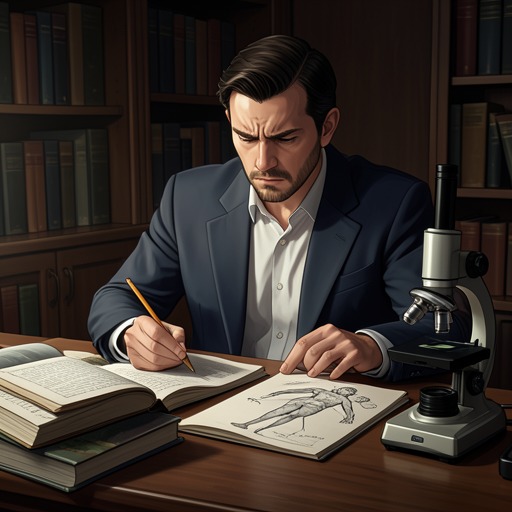
The turning point in Robert Neville’s life is his decision to replace scattered experimentation with systematic research. On April 7, 1976, he climbs the marble steps to the science room on the second floor of the Los Angeles Public Library. After days of drinking, disgust, and inconclusive investigation, he recognizes that isolated experiments cannot provide an adequate answer. He begins with blood, tentatively treating it as the rational starting point for understanding the vampire condition.
The investigation redirects the meaning of the old legends. A medical text links bacterial disease to the mechanical agency of flies and mosquitoes and describes white corpuscles, phagocytic defenses, and the circulation of extra cells during bacterial attack. These details allow Robert Neville to connect the epidemic’s frightening symptoms with mechanisms rather than supernatural curses. The mosquito becomes especially significant because it suggests a possible route by which infection could move among human beings, insects, animals, and the wider environment.
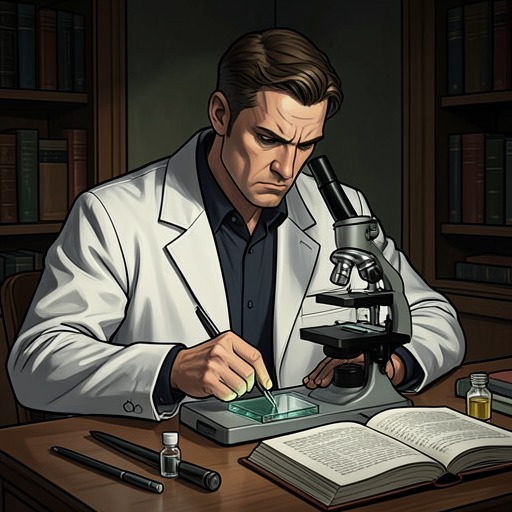
After painstaking preparation, he mounts blood samples and eventually examines his thirty-seventh slide. Under the microscope he sees a germ fluttering on the slide and realizes that the cause is not a virus, since a virus would not be visible in this way. He names the organism vampiris. Consulting bacteriology texts, he identifies it as a bacillus, a cylindrical rod of protoplasm propelled through blood by hairlike flagella. The discovery destroys the explanatory authority of centuries of vampire superstition in a single image: the vampire is not an invincible supernatural being but a biological condition with a physical agent.
His scientific conclusions remain provisional and subject to correction. Robert Neville initially interprets observations through inherited folklore, then tests sunlight, garlic, staking, blood, and infection against experience. Later, after recognizing the implications of a short biological statement, he reaches the crucial conclusion that bacteria can mutate. This realization changes his understanding of the epidemic and of the people who have emerged from it. The bacillus is not a static explanation but an evolving force capable of producing new forms and new social conditions.
Relationships, Violence, and Care
Robert Neville’s relations with other beings are shaped by the collapse of ordinary trust. He is repeatedly forced to decide whether a body is a threat, a victim, or a possible object of care. His killing of infected people makes him an executioner in the name of survival, while his encounters with women expose the tension between his wish for control and the bodily impulses he cannot fully suppress. The same man who carefully fortifies a house and conducts experiments can be shaken by the intimate proximity of a sleeping female body.
The appearance of a dog briefly interrupts his hardened isolation. On the third morning of a period of despair, he sees a dog roaming on the lawn. The animal is scrawny, limping, frightened, and quick to flee when he opens the door. Robert Neville is so shocked that he cannot move. He searches for it through yards, streets, and houses for two blocks in every direction, then leaves milk and hamburger outside, surrounding the food with garlic in the hope that the vampires will not approach it.
The attempted rescue exposes the limits of his knowledge and his capacity to protect another creature. He realizes that the dog may also be infected, yet its ability to move outdoors in daylight does not fit his existing model. He worries that the garlic will keep it away and that the vampires will kill it during the night, even imagining that he would kill himself if he found its body and believed himself responsible. When the dog finally returns, limping between the houses, he waits until it reaches the food before picking it up. It snaps at him, but he restrains its jaws and repeats that everything is all right while its nearly hairless body struggles in terror. The scene makes care a painful extension of his scientific problem: the dog is at once a vulnerable individual, a possible infected host, and evidence that his categories are incomplete.
Robert Neville’s confrontation with Ruth further unsettles his assumptions. Ruth tells him that her husband was killed the previous week, that she lost two children to the plague, and that she has spent days hiding, starving, and sleeping only a few hours at a time. From her perspective, he is not a rescuer but a persecutor who chased, struck, dragged, and exposed her to garlic before declaring her infected. Her account forces him to confront the human consequences of his procedures and the possibility that the person he classifies as diseased experiences him as a source of terror.
Change and Ending
Robert Neville’s intellectual transformation is accompanied by a change in his emotional defenses. Once he understands that the vampires are physically vulnerable and dependent on strict conditions for survival, he no longer needs alcohol merely to forget or escape. His confidence is not triumphal; it grows from the recognition that the supposedly invincible race is highly perishable. Scientific knowledge gives him an explanation, but it also makes the world more historically intelligible and therefore more tragic: the creatures outside are not demons beyond nature but a new population produced by biological change.
That change reaches its fullest meaning in the final reversal of perspective. When the new society sees Robert Neville, its voices fall silent and its white faces turn toward him with awe, fear, and horror. He understands that he is now the abnormal one, because normalcy is a majority concept rather than the standard of a single man. To the new people of the earth, he is an invisible scourge whose existence is recorded in the bloodless bodies of their loved ones. He recognizes their fear without hating them, just as the old world once feared the vampires without understanding them.
Robert Neville accepts that he does not belong to the new society and that it regards him as anathema and a black terror to be destroyed. Holding a small envelope of pills, he hopes the end will not require violence or public butchery. He swallows them as lethargy enters his limbs, and his final thought is that history has completed a circle: a new terror has been born in death, and a new superstition is entering the fortress of eternity. His last words, “I am legend,” name the reversal that defines his character. He is not remembered as the rational investigator who discovered vampiris, but as the singular monster around whom the new society will build its fear, explanations, and myths.
Narrative Role and Significance
Robert Neville embodies the collision between scientific reasoning and the social power of belief. His insight that “The strength of the vampire is that no one will believe in him” initially describes the old society’s inability to recognize the epidemic. By the ending, the same principle has turned against him. The new majority does believe in Robert Neville, but only as a legendary threat; his rational identity has been absorbed into their mythology.
His character also tests the boundary between human normality and biological difference. He begins by treating the vampires as an external enemy and himself as the last representative of the normal human world. His research complicates that opposition by showing that vampirism follows material laws, while the closing scene overturns it socially. Once the infected and their descendants constitute the majority, Robert Neville’s solitary humanity becomes the deviation. The novel’s final irony is not that science fails to discover the truth, but that truth alone cannot determine who will be called human, normal, or monstrous.
The arc is therefore one of knowledge without rescue. Robert Neville learns how infection spreads, sees the bacillus directly, recognizes mutation, and understands the physical fragility of the vampire population. He also learns, through the dog and Ruth, that observation and classification can become forms of control that injure the beings they claim to understand. His death does not restore the former order. Instead, it supplies the founding image of a new order, making him a legend precisely because he was the last person unable to survive the world that his knowledge helped explain.